
While everyone’s arguing about whether the funnel is dead, here’s what’s actually happening: the social media flywheel replacing it wasn’t built for these platforms at all, and the platforms you’re trying to grow on profit either way you frame it. Marketers keep swapping funnel diagrams for flywheel diagrams and calling it strategy.
Neither shape is the problem. The question nobody’s asking is where the friction went. It didn’t disappear. It moved.
Here’s what that means for how you should be running social right now.
Where the flywheel idea actually came from
The flywheel didn’t start as a social media concept, nor as a marketing concept. Jim Collins introduced it in his 2001 book Good to Great as a metaphor for organizational momentum: small, consistent pushes that compound into a breakthrough, rather than one big campaign. Jeff Bezos adapted it around the same time for Amazon’s specific business mechanics (lower costs feeding lower prices, feeding more customers, feeding more sellers), reportedly sketched on a napkin during a meeting with Collins in the middle of the dot-com crash.
Seventeen years later, HubSpot Co-founder Brian Halligan took both ideas and reapplied them as a general customer journey model, unveiled at HubSpot’s INBOUND 2018 keynote. The three stages, attract, engage and delight, map neatly onto HubSpot’s own product lineup at the time. That’s not an accusation of bad faith.
It’s just worth knowing the flywheel arrived as a business-alignment framework designed around a CRM company’s internal structure, not as a social media strategy. Somewhere along the way, “funnel vs. flywheel” content flooded the internet and social media got pulled into a debate it was never really part of.
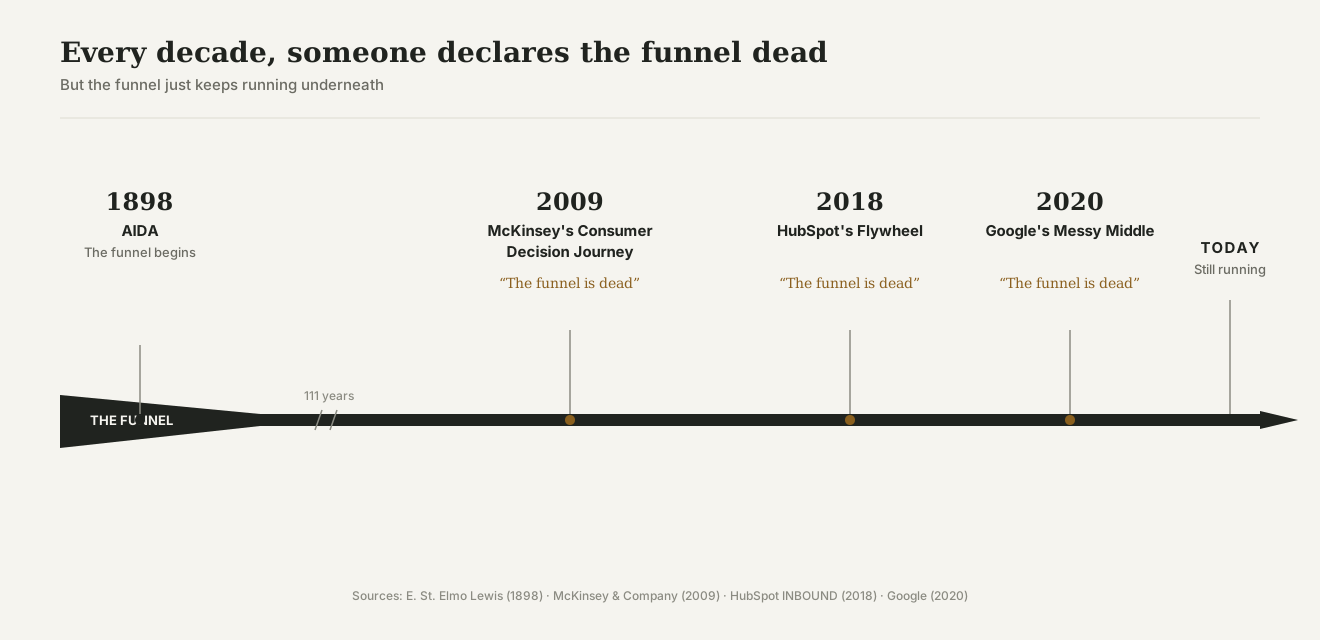
Meanwhile, the funnel it’s supposedly replacing is 128 years old. Advertising Pioneer Elias St. Elmo Lewis mapped attention, interest, desire, and action back in 1898 while studying life insurance sales. Frameworks that survive TV, radio, the internet and mobile don’t get killed off by a keynote slide.
The retention math holds up, mostly
Here’s what’s real underneath all the diagram wars: retaining customers is more profitable than chasing new ones, and the data on this is decades old. Bain & Company Researcher Fred Reichheld is the source most often cited for the claim that a 5% increase in customer retention can lift profits by 25% to 95%, a figure that has circulated in business writing since the 1990s.
Worth a caveat here, because most content repeating this stat skips it: a closer look at Reichheld’s original paper traces the upper end of that range back to a single bank’s branch system, not a universal law that applies evenly across every industry. Use the stat, but don’t treat “95%” as a promise.
The direction of the finding still holds. SaaS Capital’s own annual benchmarking shows median net revenue retention for bootstrapped B2B companies running around 103%, with top performers well above that, and retention consistently correlating with higher valuations.
None of that is specific to social media. It’s general business economics that matters more than ever right now because of what’s happening one section down.
Where the flywheel breaks on social, specifically
This is the part most funnel-vs-flywheel content skips entirely, and it’s the part that matters if you run social accounts for a living.
Organic reach has structurally collapsed across every major platform. Instagram’s organic reach dropped roughly 12% year over year heading into 2026, continuing a multi-year slide. LinkedIn fell even harder, down roughly 50% as its ranking system shifted toward an AI-curated feed that favours fewer creators over broader reach.
Facebook business pages now average under 6% reach per post, down from the mid-teens back in 2012. Accounts with fewer than 10,000 followers have a bit more reach than large ones, but the trend line points in the same direction everywhere: down.
This isn’t a punishment for bad content. It’s structural. Every platform monetizes through advertising, so unpaid reach is deliberately rationed to make paid reach worth buying.
That’s the mechanic, not a conspiracy theory. Once you understand that reach is the product being sold, not a feature being taken away, you stop wondering why your engagement dropped and start planning around it.
So here’s the practical problem with importing a “flywheel” straight from a CRM company’s 2018 keynote onto social: the flywheel’s entire “attract” stage assumes you can reliably reach an audience through consistent effort. On platforms that actively throttle free reach, that assumption doesn’t hold as it does in email or search.
The gatekeeper didn’t disappear; it moved
Here’s the pattern once you step back far enough to see it. HubSpot’s 2018 flywheel pitch argued that the funnel failed because it treated the customer as an afterthought once the sale closed, leaving all the friction between departments. Fair critique for a sales organization.
But on social specifically, the friction the flywheel promises to eliminate hasn’t gone away. It’s just been relocated to a different owner.
TikTok’s own business team frames this directly, distinguishing “open loop” selling (a customer discovers your brand on TikTok and then buys on your own site) from “closed loop” selling (discovery and purchase both occur within TikTok Shop). Closed loop converts better, and TikTok’s own account staff will tell you that. It also keeps the entire transaction inside TikTok’s infrastructure rather than sending traffic to yours. LinkedIn’s pivot toward video and paid creator partnerships tracks the exact same logic: throttle organic reach, then sell the fix back to you.
That’s the honest version of “the flywheel replaces the funnel.” It doesn’t. The gate that used to sit between a salesperson’s information advantage and a prospect in the 1990s now sits inside a recommendation algorithm deciding whether your post reaches anyone who hasn’t already engaged with you. Retention and advocacy genuinely reduce how often you need to open that gate. They don’t remove it.
Why the funnel isn’t actually dead
Marketing Week Columnist Mark Ritson has spent years pushing back on “funnel is dead” claims, including Sheryl Sandberg’s 2016 assertion that the funnel was collapsing under digital pressure. Ritson’s response holds up: “reports of the death of the sales funnel are greatly exaggerated”, and critics calling it dead are usually mistaking their own tactics for the underlying strategy.
He’s got history on his side. The flywheel isn’t the first attempt at a funnel replacement, and it won’t be the last. McKinsey proposed a circular “consumer decision journey” back in 2009, nine years before HubSpot’s keynote, and it’s barely mentioned in flywheel content today despite getting similar coverage at the time.
Google’s own 2020 research, built on roughly 310,000 simulated purchase scenarios, found something closer to a chaotic loop than either a funnel or a flywheel: buyers bounce repeatedly between “exploring” options and “evaluating” them, sometimes switching brand preference within minutes of seeing a competitor. That’s a third model entirely, and it’s arguably better supported by data than either the funnel or the flywheel.
Roughly every decade, a company at a strategic inflection point proposes a new shape to replace “the dead funnel.” Each one generates a wave of copycat content. None of them has actually killed it off. The funnel is still the thing everyone quietly falls back on to explain where a campaign leaked.
What this means for your social strategy
None of this means ignoring retention, community or advocacy on social. It means not importing a CRM company’s org chart and calling it a content strategy.
Sprout Social’s own funnel model already reflects where the industry has landed without needing to rebrand it as a flywheel: awareness, consideration and action, followed by engagement and advocacy stages that loop back into new awareness through hashtag campaigns, community chats and customer-story content. That’s a funnel with flywheel logic welded onto the back of it. It’s a more honest description of what’s actually working than either pure framework on its own.
Look closely at the people actually running something like this, and you’ll notice something else: the real momentum usually lives in the infrastructure they own, not in the platform itself. Creator email lists built through consistent social content, not the social platforms directly, are where segmentation, feedback loops and repeat engagement compound. Social’s real job in that structure is the attract stage and the repurposing surface, not the whole engine.
The bottom line
The industry is shifting, but not in the direction most funnel-vs-flywheel content claims. The retention economics are real. The reach decline is real, and it’s structural, not a bad week for your account.
What’s not real is the idea that swapping shapes solves either problem. Build for retention because the math supports it. Plan for paid amplification because platforms are built to require it.
Keep a funnel-shaped view of your metrics anyway. You’ll need it the moment someone asks where the campaign leaked.
Position your strategy for what’s actually happening on these platforms, not for what a decade-old keynote slide promised. That’s the advantage that compounds.